
Federal Releases Serving Hopkins
The BOP list of Texas facilities does not identify a prison in Hopkins County. The county jail can still hold someone connected with a federal matter. USMS manages many pretrial detainees and transports people among courts, contract jails, and later BOP designations. A person who disappears from the Hopkins current roster may therefore remain confined elsewhere.
A federal criminal case has stages. Arrest and pretrial detention may occur under USMS responsibility. A sentenced person can later enter BOP custody. At the end of BOP confinement, the locator may show a past release date and no current institution. Federal supervised release, a court-ordered period monitored in the community, is separate and may remain active.
| Event | Meaning | Next source |
|---|---|---|
| Leaves Hopkins jail for USMS | Federal transport, not community release | Federal docket and USMS channel |
| Assigned to BOP institution | Federal sentence custody | BOP locator |
| BOP past release date | No longer in BOP custody on that record | Court and supervision records |
| Another detainer | Custody may continue elsewhere | Receiving agency |
Search BOP Release Records
Use the official BOP Inmate Locator. A register number is the best key. The name search can also use age, race, and sex to distinguish results. Copy the wording exactly because a current institution, an in-transit state, and a completed release are not interchangeable.
- Search by BOP register number when it is known.
- Otherwise enter the full name and use the available identity fields.
- Compare the result with the federal case and Hopkins booking identifiers.
- Read the release-date and location fields together.
- If no useful match appears, review the federal docket and determine whether the person remains in a USMS stage.
- For a historical document beyond the locator, use BOP FOIA and any required identity or consent form.
The Hopkins County released-inmate workflow helps connect the county movement record to the right federal result. The county record should name the receiving authority when a transfer occurred.
Read Federal Release Results
The BOP locator explanation describes the result fields and historical limits. The matching manifest image shows the official interpretation source:
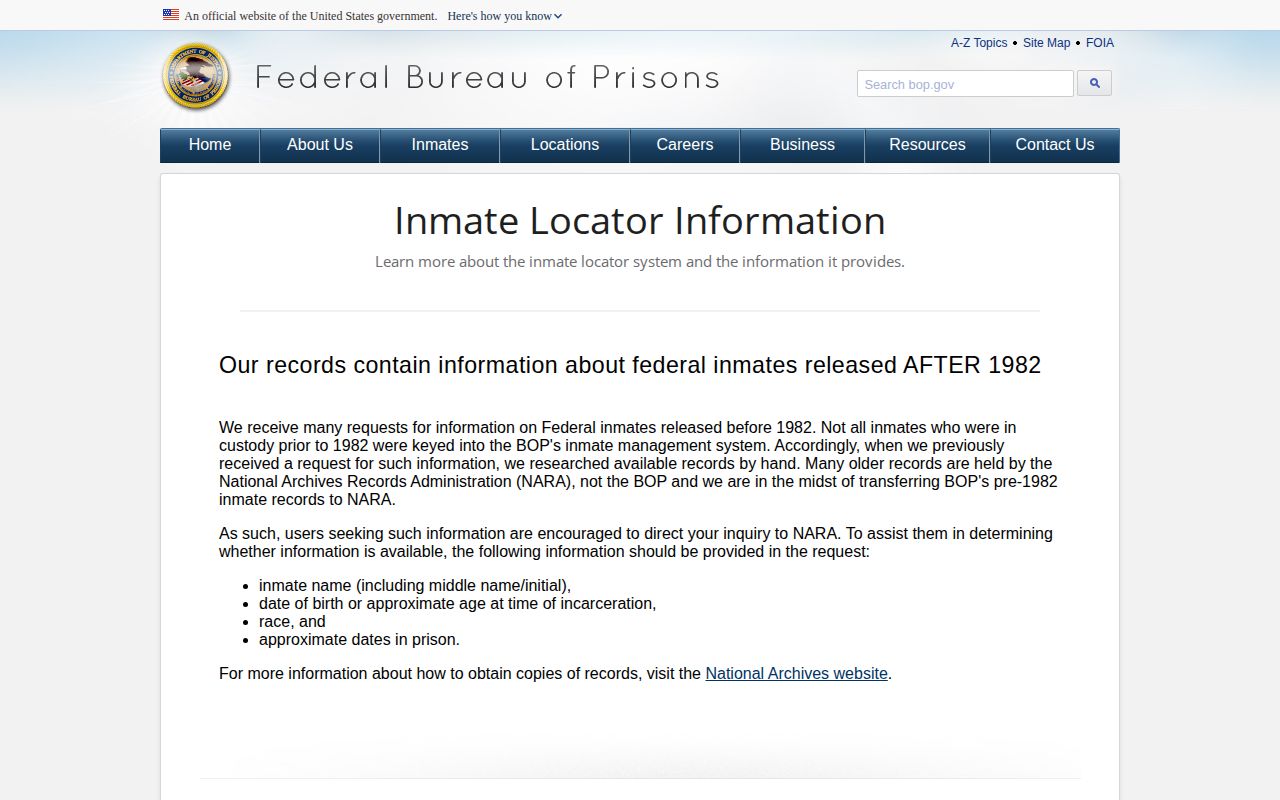
A past date with no current facility generally means the person left BOP custody on that date. A result marked released likewise means no current BOP custody. Record the exact phrase instead of replacing it with a broader claim. BOP warns that older data may not be complete, so a formal record request or court file may be needed.
| BOP field | What it contributes |
|---|---|
| Name and register number | Identity and unique federal record key |
| Age, race, and sex | Match checks, not sole proof of identity |
| Location | Current BOP institution or no current location |
| Release date | Projected or completed federal custody date in context |
Note: Preserve the access date because online custody and location fields can change after review.
USMS Hopkins Transfer Records
There is no public USMS historical person-level release roster comparable to the BOP locator. When the Hopkins jail’s arresting-agency or destination field identifies a federal authority, use the federal court docket and detention or release order. Then seek the jail movement record and contact the relevant USMS prisoner-operations channel if needed.
A 2020 local report about a temporary USMS housing agreement described transport from Sherman, Tyler, Texarkana, and Plano, followed by movement to court or a federal penitentiary. It illustrates the mechanism but does not prove the same contract is active in 2026. The safe statement is that Hopkins has documented federal transport history and that each current event needs its own record.
- USMS custody
- Federal pretrial, court, and transport responsibility that may precede BOP designation.
- BOP custody
- Federal prison-system confinement, usually after sentencing.
- Supervised release
- Court-ordered federal community supervision after confinement.
- Detainer
- Authority that may send a person to another custodian instead of the community.
Federal Release Record Requests
The locator is the first public channel, not the only one. Detailed BOP records use the agency’s FOIA process. Identity or consent requirements may call for DOJ Form 361. Ask for a defined record and date range. Broad questions may not require an agency to create a new explanation. The federal case clerk is the source for detention orders, judgments, sentence documents, and supervised-release terms.
A Hopkins County open-records request should ask for the county booking and movement records, including the receiving authority, transfer time, and legal basis. Federal FOIA then covers the federal agency’s own file, subject to privacy and other lawful exemptions. Certified court copies come from the court rather than BOP or the sheriff.
Federal custody contactsBOP Inmate Locator: official self-service search
USMS: prisoner operations and the relevant district office
Federal court clerk: case orders and judgment
BOP FOIA: detailed agency records
No public local BOP release desk exists in Hopkins County because no BOP institution was identified there.
Federal Release Versus ICE
BOP and ICE are separate systems. BOP manages federal criminal imprisonment. ICE manages civil immigration detention through its own facilities and contracts. A person can complete BOP custody and then move to ICE, so the BOP release date may mark only the end of the criminal custodian’s role.
If the county or federal record names ICE, use the ICE locator quickly because recent-release visibility is limited. If it names a state or county warrant, use that receiving system. A federal court’s sentence completion does not cancel an unrelated hold. Describe each transition by custodian and date rather than compressing the chain into one “released” event.
No. It means BOP custody ended on the displayed record. Supervision, immigration proceedings, or another hold may remain.
Verify Hopkins Federal Release
The strongest federal verification chain starts with the Hopkins booking or movement record when local custody was involved. Next comes the federal docket, which shows detention authority and sentence. The BOP locator supplies the prison-system location or release date. A formal agency response resolves details not held in the public locator.
Do not report community release from roster absence. Do not treat IN TRANSIT as release. Do not use a county bond amount to predict a federal departure. Each record has a defined scope. When sources conflict, prefer the underlying agency document, note the conflict, and ask the custodian to clarify the status.
Record the Hopkins movement time, federal register number, court case, BOP release date, and any receiving agency as separate entries. This preserves the custody sequence and avoids turning a transfer into a final discharge.
Note: A precise custody timeline is more accurate than a single broad release label.