
ICE Transfers From Hopkins Jail
ICE’s current detention-facility directory lists Hopkins County Jail, though no separate ICE detention facility or dedicated contract facility was identified in Hopkins County. The directory relationship makes the immigration-transfer warning concrete. When a county release record names ICE, Hopkins custody ended, but ICE custody may have begun at once.
A detainer is authority or a request that can cause a person to be delivered to another custodian after the local criminal basis ends. It does not state when ICE later released the person. The sheriff record should identify the destination, time, and authority. The ICE record then answers the next custody question.
| Record statement | Accurate reading |
|---|---|
| Released to ICE | County custody ended; immigration custody may continue |
| Currently detained in ODLS | ICE displays present detention |
| Recently released from ICE | ICE custody ended within the locator’s limited scope |
| EOIR case entry | Immigration proceeding status, not physical custody proof |
Search ICE Hopkins Records
Use the ICE Online Detainee Locator. It supports an A-number search paired with country of birth and a biographical search. Exact spelling matters. An A-number is the most direct immigration identifier, while a name search may require multiple spellings.
- Obtain the person’s full name, date of birth, country of birth, and A-number if available.
- Search by A-number and country of birth first.
- If needed, try the biographical search with the exact name and birth details.
- Compare the result with the Hopkins final release destination and timestamp.
- If the locator shows detention, use its facility information and ICE ERO contact route.
- If it shows recent release, preserve the result and seek records when documentary proof is needed.
Official ICE guidance says ODLS includes current detainees and people released from ICE custody within the prior 60 days. That makes prompt checking useful. It is not a complete historical release database. After the window, a no-result page may mean the record aged out, identity data differ, the person was outside locator scope, or no matching detention exists.
Note: Save the exact result wording and access date because ICE custody data can change.
ICE Detainee Result Limits
ODLS does not replace the Hopkins sheriff release sheet. Nor does it replace an immigration court record. Each source documents a different layer: county physical custody, ICE detention, and immigration adjudication. A no-result should never be presented as proof of community release, case dismissal, or the absence of an immigration matter.
- A-number
- An immigration identifier used for the most direct ODLS search.
- Biographical search
- A name and identity search that can be sensitive to spelling.
- ERO
- Enforcement and Removal Operations, the ICE component handling detention and field operations.
- Detainer
- The mechanism that can lead to transfer when another custodian’s hold ends.
- Removal proceeding
- An immigration court matter that can continue with or without detention.
When sources disagree, verify identity first. Then ask the county for its receiving-agency record and ICE for its own custody record. The sequence prevents a transfer timestamp from being mistaken for an ICE release date.
ICE Dallas Field Office
Hopkins County falls within the practical reach of the ICE Dallas ERO field-office channel. Use the official page for current contact details and office instructions. No public ICE release desk was identified in Hopkins County. The online locator remains the first person-specific public route.
ICE ERO Dallas Field OfficeUse the official field-office page for current address, telephone, and appointment rules.
ICE Online Detainee Locator: current and limited recent-release search
Have the A-number, full name, date of birth, country of birth, Hopkins booking number, and county transfer date ready. Staff may be limited in what they can disclose. A focused request tied to an identified event is more useful than asking an office to reconstruct the whole criminal and immigration history.
The Hopkins County release search explains how to obtain the local final release screen before following the federal destination. That county record anchors the start of the ICE timeline.
ICE Release and EOIR Status
The EOIR Automated Case Information System may preserve immigration proceeding information after ODLS no longer shows a recent release. The matching manifest image captures the official court portal:
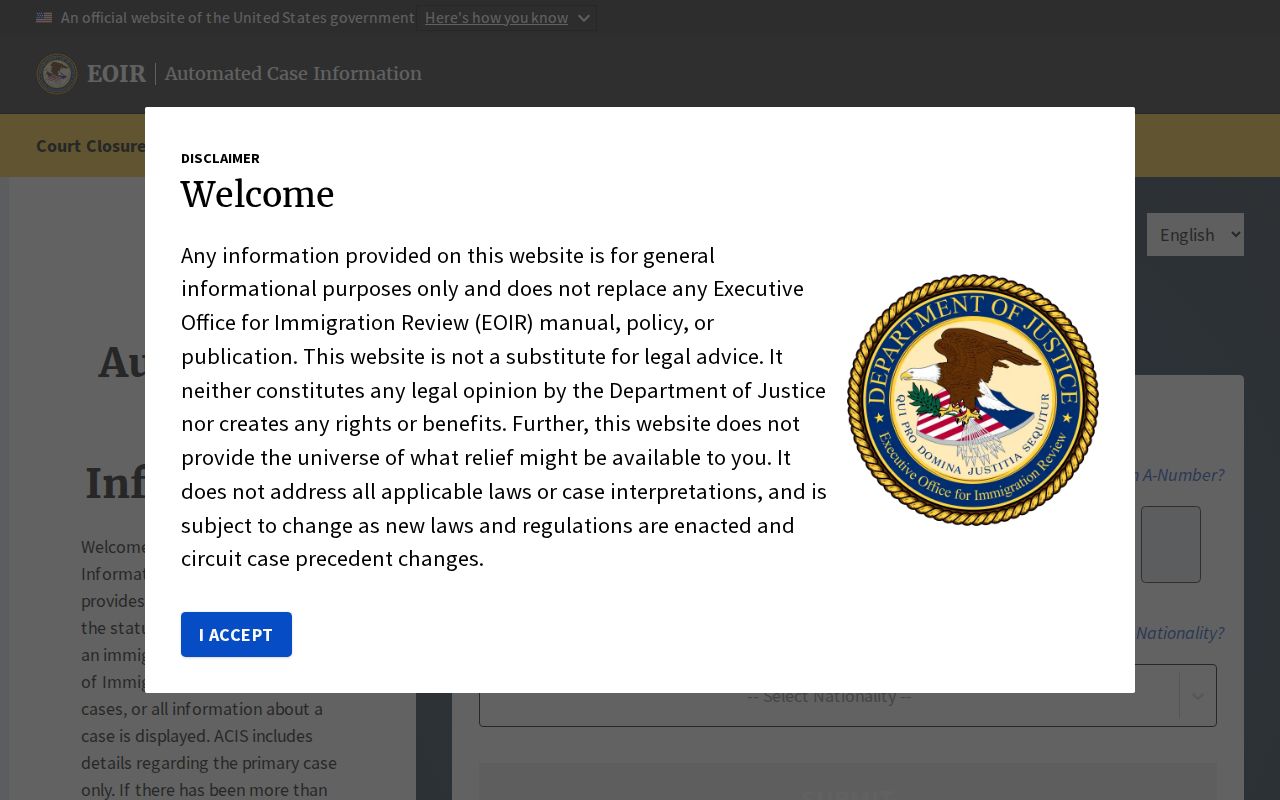
EOIR reports adjudication information. It cannot prove that a person is physically detained or released. A proceeding may continue after release from ICE custody, and a decision may appear while custody status changes elsewhere. Use the portal to understand the case, then use ICE records for custody.
EOIR Automated Case Information is also available by telephone at 800-898-7180, with TDD service at 800-828-1120. Those channels remain separate from the ICE locator. A court hearing date does not establish release, and an ICE release does not by itself end the immigration proceeding.
Request ICE Release Records
When ODLS is incomplete or the 60-day window has passed, use the applicable ICE records process. State the A-number, full name, birth details, approximate detention dates, facility, and the specific existing records sought. Privacy rules and exemptions may limit disclosure. If the request is made for another person, identity or consent documentation may be required.
Request the custody history, transfer record, and release record or date when appropriate. The Hopkins request should separately seek the jail’s final release screen, transfer destination, authority, and movement time. The two records should meet at the transfer. If BOP or USMS also appears, create a custodian-by-custodian timeline rather than assuming ICE received the person directly.
| Custodian | Record to request |
|---|---|
| Hopkins County | Final release and receiving-agency movement record |
| ICE | Detention, transfer, and release history |
| EOIR | Immigration court case and decision record |
| USMS or BOP | Federal criminal custody record when involved |
Note: Ask for existing documents, not a new narrative that combines files held by several agencies.
Hopkins ICE Custody Crossroads
Hopkins County’s records show why destination matters. The county vendor records arresting agencies, the ICE directory lists the jail, and local reporting documents past federal transport arrangements. Together, those sources show a real custody crossroads. They do not establish that each absent roster name went to federal or immigration custody.
A careful release statement identifies the custodian. “Released from Hopkins County Jail to ICE” describes one transition. “Released from ICE custody” describes another. “Immigration case closed” is an adjudication result. These phrases should not substitute for one another.
Prompt verification is best because ODLS recent-release visibility is limited. Preserve dates and exact status wording, then obtain the underlying record if the event must be documented. If the locator is silent, say the result is unknown and continue with the records route.
Verify ICE Community Release
The strongest chain begins with the Hopkins County final release screen. It should identify ICE or another receiving custodian. Next, search ODLS and record the current or recent status. If the person is no longer visible, seek ICE custody history. Use EOIR only to add court context.
Another hold can follow ICE custody, just as ICE can follow county or BOP custody. Community release should be stated only when the responsible custodian’s record supports it and no known transfer explains the departure. Even then, an immigration case or reporting duty may continue outside detention.
No. The locator has scope and time limits. Confirm through ICE records and the prior custodian’s transfer information.