
Hopkins Projected Versus Actual Release
TDCJ uses the exact field Projected Release Date. It is calculated by the Correctional Institutions Division Classification and Records Office and estimates when incarceration will end if parole does not happen sooner. It is not the date a person walked out. A Scheduled Release Date can appear later, once release processing has advanced, but TDCJ warns that even a scheduled date may change without notice.
County custody works differently. A Hopkins County Jail detainee awaiting trial has no sentence-based projection. Bond may be set yet remain unpaid, a judge may change an order, or another agency may hold the person. A sentenced county detainee may receive jail credit and good-conduct commutation, but the public roster does not calculate a dependable departure date.
Find Hopkins County Release Dates
Identify the last custodian before searching. The Hopkins roster cannot provide a TDCJ release date, and TDCJ does not calculate a local bond release. Use a SID or TDCJ number for a state prisoner when possible. Name searches require comparison with sex, race, offense, and conviction county.
- Check Hopkins Current Inmates to learn whether the person is still displayed as booked locally.
- For a state sentence, open the TDCJ Online Inmate Search and search by TDCJ number, SID, or name.
- Read Projected Release Date separately from parole eligibility, maximum expiration, and any Scheduled Release Date.
- For a county sentence, obtain the judgment, jail-credit language, commitment, and the jail's current calculation.
- Recheck the controlling agency and obtain the final release record after departure.
If a person no longer appears online, TDCJ's email information route can supply prior incarceration history. The Hopkins County release-record path covers local booking sheets, court causes, and transfer checks.
Texas Good Time Release Rules
Texas Government Code Chapter 498 controls state good-conduct time. Section 498.003 says good time affects eligibility for parole or mandatory supervision and does not otherwise shorten the sentence term. It is a privilege, not a right. Classification, participation, legal eligibility, forfeiture, and restoration all affect the credit recorded by TDCJ.
There is no blanket Texas rule requiring every prisoner to serve 85 percent. Under Government Code Section 508.145, an ordinary eligible case generally reaches initial parole eligibility when calendar time plus good conduct equals one-fourth of the sentence or 15 years, whichever is less. Certain serious offenses and deadly-weapon findings generally require one-half of the sentence or 30 years in actual calendar time, and good time does not advance that threshold. Other categories have distinct rules.
Eligibility is only the first point at which the Board may approve parole. It is not physical release. Mandatory supervision also depends on offense date, statutory exclusions, and, for many cases, Board review. A denial can shift the projection toward maximum expiration.
Why Hopkins Release Dates Change
A displayed date reflects the record at that moment. New credits, disciplinary action, a corrected sentence, or a receiving-agency hold can alter the calculation. A parole approval is also a processing stage, not proof of departure.
| Factor | Possible effect |
|---|---|
| Credit posting or correction | Changes flat-time or jail-credit calculations. |
| Good-time forfeiture or restoration | Changes parole or mandatory-supervision eligibility inputs. |
| Concurrent or consecutive terms | Changes how multiple sentences combine. |
| Detainer or warrant | May block community release or send the person to another agency. |
| Board decision | Approval, denial, or setoff changes the expected path. |
| Court or appellate order | Can revise the judgment, sentence, or lawful custody basis. |
Release-plan approval, classification events, and identity corrections may also change the screen. Call the relevant status channel shortly before travel.
Confirm Hopkins County Release Timing
For a TDCJ case, check the offender detail, then use the Parole Status Line when review is pending. After a favorable Board vote, Review and Release Processing can address release status. That office coordinates eligible parole and mandatory-supervision releases, including plan and certificate work that may remain after a vote.
Current release notifications use Texas IVSS, not the obsolete county VINE interface. The Hopkins County VINELink inmate search explains the county and TDCJ portals. An alert is useful event evidence, but the custodian's status/history or release sheet remains the documentary source.
The relevant manifest capture comes from TDCJ's official definitions.
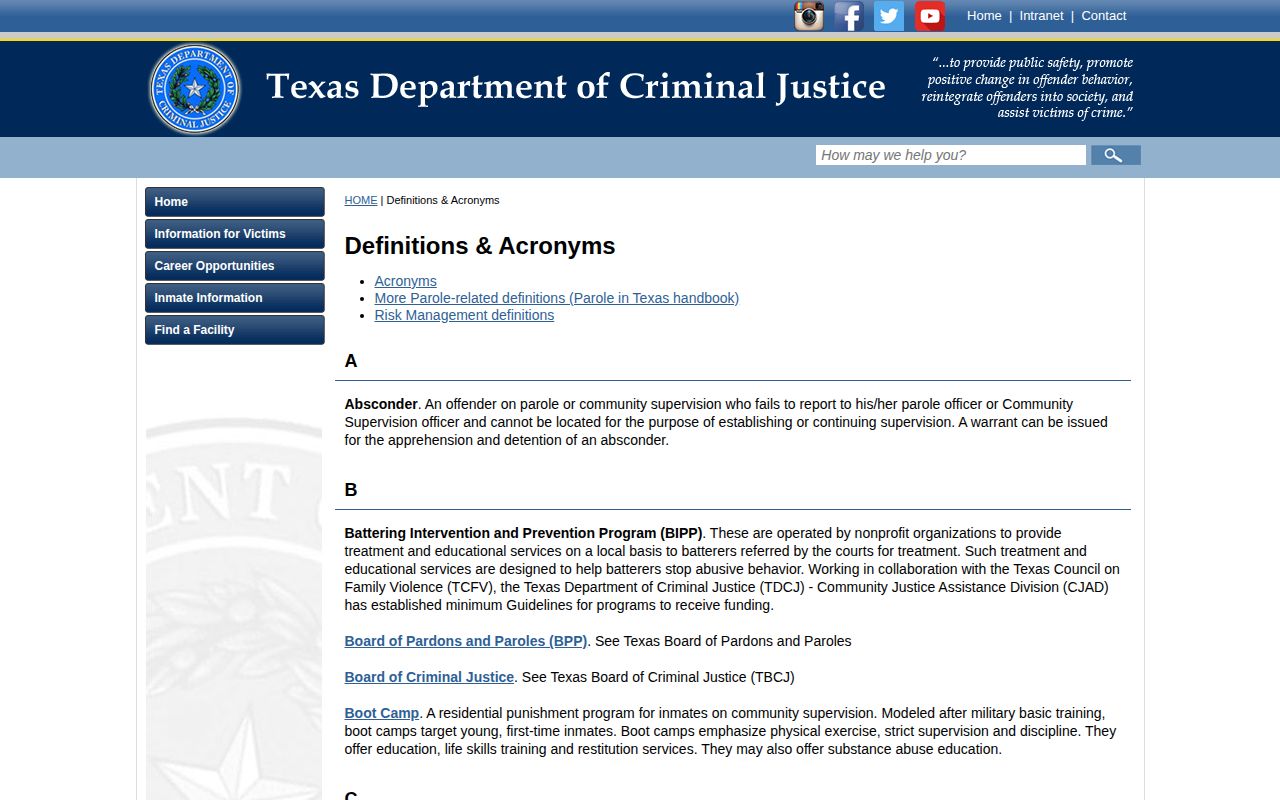
The definition confirms that projection is a Classification and Records calculation and can be displaced by an earlier parole release.
Hopkins County Jail Good Time
Texas Code of Criminal Procedure Article 42.032 authorizes a sheriff to grant commutation for good conduct, industry, and obedience on a county-jail sentence. The reduction can be up to one day for each day actually served when the statutory conditions and local record support it. This is discretionary authority, not an automatic calculator.
A sound request asks the Hopkins County Jail for the commitment, credited days, good-conduct entries, and the current release calculation. The court judgment shows the sentence and any stated jail credit. The jail record shows the custodian's computation and final departure. Neither record should be guessed from the public current-inmate page.
Three TDCJ Release Dates
Parole eligibility is when legal consideration can begin. Projected Release Date is the TDCJ calculation if no earlier parole occurs. Maximum expiration or discharge concerns the end of the sentence calculation. The terms answer different questions, and none should be substituted for an actual release entry.
- Parole eligibility
- The first date the Board may consider release under the applicable law.
- Projected release
- The forward-looking TDCJ calculation based on current legal and record inputs.
- Scheduled release
- A later processing field that may include a release location but can still change.
- Actual release
- The completed custody event recorded by the custodian.
For mandatory-supervision-eligible offenses committed before September 1, 1996, TDCJ explains that flat time plus good time reaching the term can trigger release if parole has not occurred. Later eligible cases require discretionary Board approval. A person excluded from mandatory supervision may project toward maximum expiration instead.
A Board vote has its own vocabulary and timing. An approval code can carry a condition, treatment requirement, or target month. A denial can set a later review. The public result should be transcribed as shown and checked against the Board's official voting-options explanation. Turning an approval code into a firm pickup date skips the work of release planning, certificate preparation, and hold clearance.
A Hopkins conviction does not mean the person is housed in Hopkins County. TDCJ classification may place a sentenced person at a unit elsewhere in Texas, and the official unit or scheduled release location controls logistics. Conversely, a person serving a county sentence at 298 Rosemont is not found through the TDCJ projection field. The commitment and jail calculation are the correct local records.
Transfers also change the meaning of “release.” A person can leave Hopkins County Jail for TDCJ, another county, federal custody, or ICE without entering the community. Ask the jail for the receiving agency. If TDCJ later displays a release date, that date concerns departure from state incarceration rather than the earlier county transfer.
For an older state record that is no longer clear online, use TDCJ's inmate-information email route. Include the full name and seven-digit TDCJ number, or the exact birth date or approximate age and county of conviction. That channel can provide current and prior incarceration information. Documents beyond the published fields may require the agency's formal public-information process.
After release, compare the final TDCJ status with any supervision record. “Under Supervision” means parole or mandatory supervision continues. “Out of Custody” shows departure from the displayed custody category, but it should be paired with the release date and status history. Full discharge is a different endpoint from supervised release.
County court records add another layer. A judgment can state sentence length and jail credit, while a later order can alter the lawful basis for custody. Yet the court docket does not timestamp the jail door. Request the Hopkins County final release screen after the event and compare its release type with the judgment and any receiving-agency entry.
Do not calculate a date by subtracting a fixed fraction from the sentence. Stacked sentences, offense-specific exclusions, disciplinary history, credits, and detainers make that shortcut unreliable. The current agency calculation is the starting point, and the final agency record is the endpoint.
Source date: August 2, 2026. Recheck TDCJ or Hopkins County shortly before relying on a date, especially when planning pickup or travel.